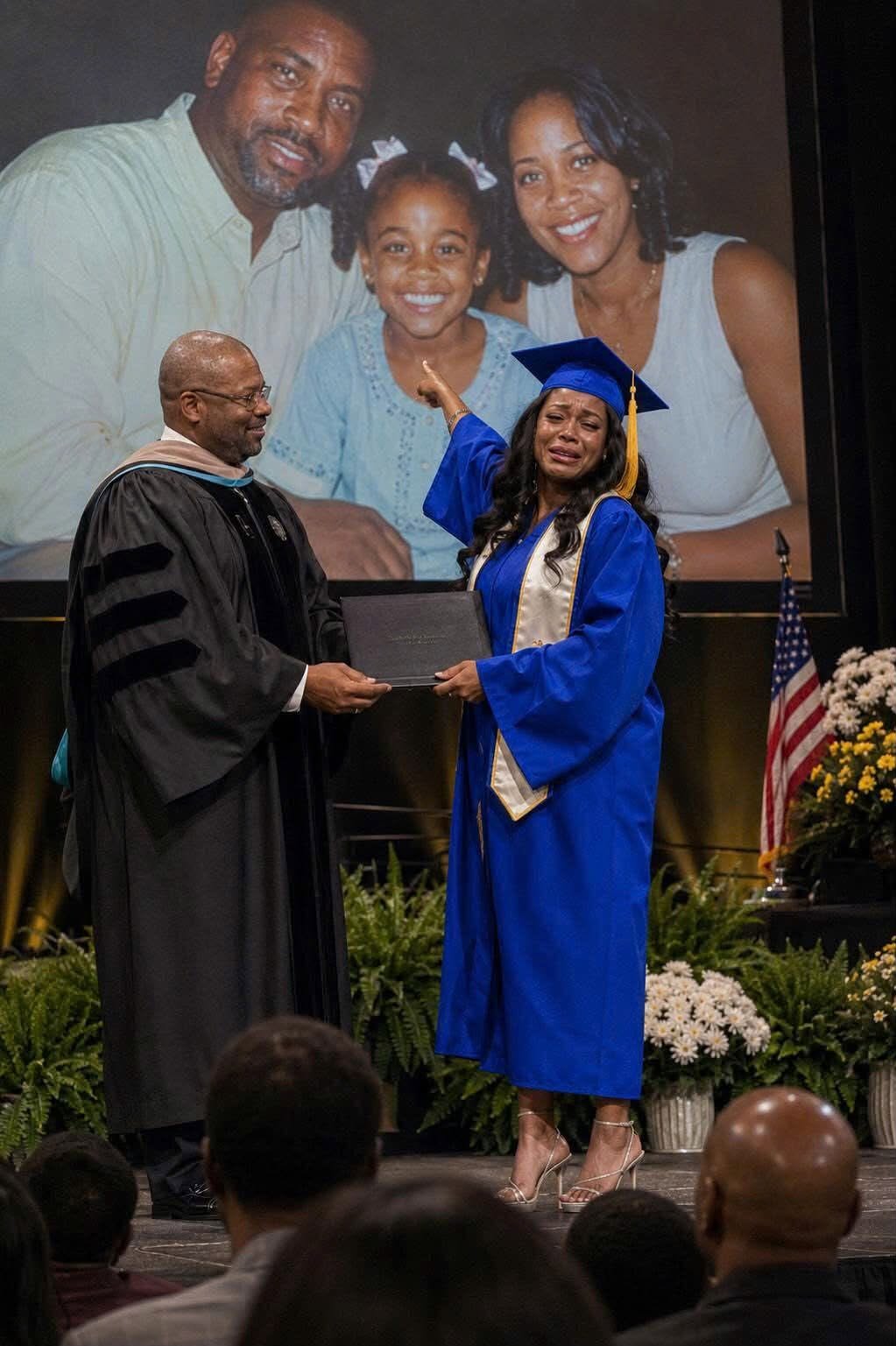
And then I felt two hands come down gently over my eyes from behind, warm and steady, blotting out the whole bright field in an instant of total dark.
A voice — deeper than I remembered, closer to my ear than any stranger had a right to be — said, low enough that only I could hear it over the noise of the crowd:
“Guess who finally made it?”
VII.
I spun around so fast my cap nearly slipped off my head.
Caleb stood there in a dress uniform I’d never seen him wear, his hair shorter than I remembered, his face older in the particular way three years and one very hard year in between will age a person. He looked nervous in a way I’d never associated with my brother before — the same nervous I imagine I looked, walking across that stage seconds earlier, uncertain whether the ground underneath either of us was actually as solid as it needed to be.
“You’re supposed to be — ” I couldn’t even finish the sentence. I didn’t know how to finish it. Overseas. Gone. Someone I used to have.
“I know,” he said. “I know exactly how long it’s been, Peanut. I’ve counted every single day of it.”
I hit him, once, in the chest, not hard, more instinct than anger, the same gesture I might have made at eleven years old when he’d teased me about something small. Then I was crying, the kind of crying I hadn’t fully let myself do since the funeral, and he pulled me into a hug tight enough that I felt, for the first time in seven months, like something in my chest that had been braced and rigid for a very long time was finally allowed to loosen.
“I’m sorry,” he said, into my hair, his own voice breaking. “For all of it. For not coming home in November. For every call I let go too long between. I told myself I had good reasons, and maybe some of them were even true, but none of them were good enough, and I knew that the whole time, even while I was making them.”
“Grandma sent you Dad’s letter,” I said, pulling back enough to look at him.
“She did.” His eyes were wet now too. He reached into the inside pocket of his uniform jacket and pulled out the same yellowed envelope Grandma had shown me the night before, the seal broken now, the paper inside worn soft at its folds from what must have been dozens of readings on however many planes and transports had carried him home. “I read it on a transport plane somewhere over an ocean I couldn’t even tell you the name of, and I don’t think I’ve cried like that since I was a kid.”
He held it out to me. “She told me she showed you the envelope but wouldn’t let you read what’s inside. Said it wasn’t hers to give away twice.” His hand was steady but his voice wasn’t. “I think it’s supposed to be mine to give you now.”
I took the letter with hands that weren’t steady either. The handwriting was smaller than I remembered our father’s being, more careful, like he’d rewritten certain lines more than once before he was satisfied.
Caleb, it began. I’ve started this letter more times than I want to admit, and thrown out every version until this one, so forgive me if it still isn’t as good as it should be.
I was wrong about the store. I was wrong to make you feel like choosing something different meant choosing against this family. I’ve watched you become the kind of man I hope your sister grows up to admire, and I’ve been too proud, for too long, to tell you that out loud. I don’t want to lose any more years to a fight that was never really about a hardware store to begin with. Come home when you can. Call before that, if you’re willing. I’m not asking you to forgive three years overnight. I’m only asking you to let me start trying.
Your father, who is prouder of you than he has ever managed to say.
I read it a second time before I could speak. “He wrote this a month before,” I finally managed.
“A month before,” Caleb repeated, his voice catching in the exact same place mine had, the night before, hearing the same fact from Grandma. “I don’t know if I’ll ever fully make peace with how close that timing was. But I know I’m not going to waste any more of it, whatever’s left.”
VIII.
We found Grandma Vivian afterward, still seated in her folding chair, tears streaming freely down a face that had spent seven months working very hard to stay composed for my sake. Caleb knelt in front of her wheelchair-adjacent seat and took both her shaking hands in his, the same way she’d taken mine that morning at the kitchen table.
“Thank you,” he told her, “for not giving up on getting through to me. For three years, honestly. Not just this last one.”