“I wasn’t going to let this family lose one more person to silence,” she said, “not while I still had breath enough to write a letter.” She looked between the two of us, her hands still trembling but her voice, for the first time in months, sounding entirely certain of something. “Your father would have wanted exactly this. I like to believe some part of him knew, even before the accident, that this day was still coming. He just didn’t get to see it arrive the way the rest of us finally have.”
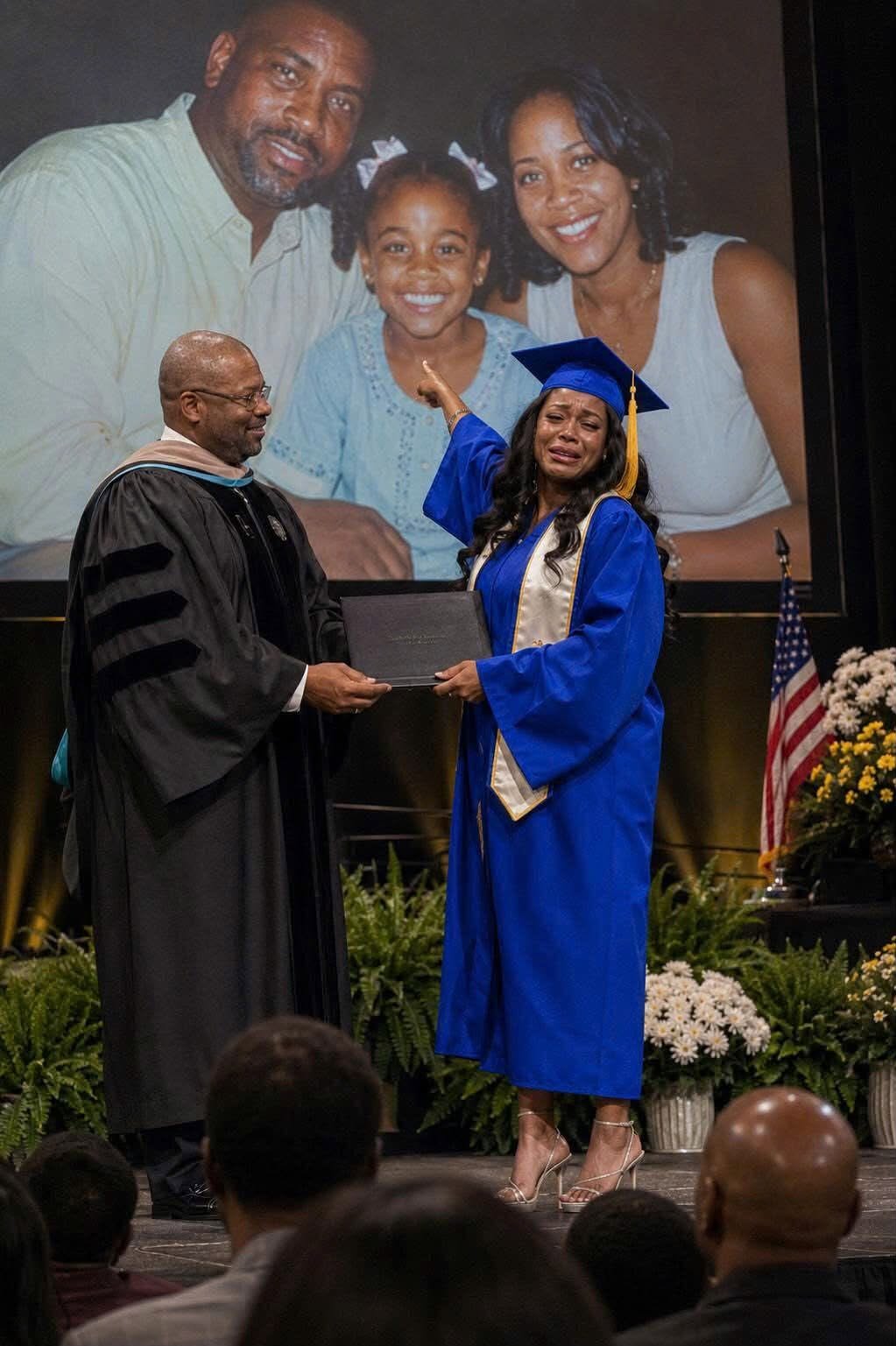
We took a photograph in that football field a little while later — not the kind with a sign held up high, not the kind with a dozen relatives crowded in close, just the three of us who were left, standing together in the June light, my diploma held against my chest like something I’d almost let myself believe I was walking toward alone.
I keep that photograph now, framed, on the nightstand beside my bed. Not because it undoes the year that came before it. It doesn’t. My parents are still gone, and no reunion, however overdue, changes the shape of that particular loss.
But it reminds me, on the mornings it’s hardest to remember, that the people who love you sometimes have to travel through more silence, more distance, more unsent letters than you ever know about, before they finally find their way to standing behind you again — close enough, in the end, to cover your eyes with their own two hands and ask you, in a voice you thought you’d never hear that near to you again, to guess who finally made it home.
IX.
Caleb stayed in Milbrook for eleven days before his leave ran out. It wasn’t nearly long enough, and both of us knew it going in, but we spent those eleven days trying to make up for more lost time than eleven days could reasonably hold.
We drove past the house where we grew up, the one Grandma had eventually decided to keep instead of sell, and Caleb walked through every room slowly, the way you walk through a place that used to be simple and isn’t anymore. He stood the longest in our father’s old study, in front of the desk where the letter had waited, unsent, for eight months longer than anyone realized.
“I keep thinking about what would have happened,” he told me, one evening on the back porch, “if I’d come home even once during those three years. If I’d made one visit happen instead of always finding a reason it wasn’t the right time yet. I might have gotten to hear some of what was in that letter out loud, from him, instead of on paper, after it was too late for him to say it himself.”
“You can’t live inside that question forever,” I told him, surprising myself with how certain I sounded. “Grandma taught me that, this year, more than she probably realizes. She lost her son and she still found a way to write a letter instead of just grieving what already happened. I think that’s the only way any of us actually get through something like this. You keep writing the next letter instead of rereading the one you can’t take back.”
He looked at me like he was seeing, for the first time since he’d covered my eyes on that football field, exactly how much I’d grown up without him there to watch it happen.
“When did you get so wise, Peanut?”
“Around the same time I stopped having a choice,” I said, and neither of us laughed, though something in the honesty of it felt like the beginning of one, eventually, further down the road than either of us had reached yet.
X.
Before he left, Caleb sat down with Grandma Vivian at the kitchen table, the same table where she’d taken my hands the morning of graduation, and the three of us talked, for the first time as a complete remaining family, about what came next.
He couldn’t leave the Army immediately — his enlistment ran another eighteen months, he explained, and walking away early wasn’t something he could do without consequences that would ripple through the rest of us too. But he promised, in a way I believed because I watched him mean it while he said it, that eighteen months would look nothing like the last three years had. Weekly calls. Visits whenever leave allowed it. A seat held for him, permanently, at whatever table our family gathered around from now on.
“I’m not going to let another letter sit in a drawer,” he said, “waiting for a better time that might not come. I learned that lesson about as hard as a person can learn it.”
Grandma reached across the table and covered his hand with hers, the tremor in her fingers steadier, somehow, than I’d seen it in months. “Your father would tell you the same thing, if he still could,” she said. “So I suppose it falls to me now. Don’t wait, Caleb. None of us know, in the end, how much time any of this actually gives us.”
XI.
I think about that graduation morning often — the version of myself standing in the kitchen in my cap and gown, asking what the point was if no one was going to be there. I understand now that I had the question slightly wrong from the start. It was never really about whether someone would be there. It was about how far someone was willing to travel, through however much silence and hurt and unfinished business stood in the way, to make sure they eventually were.