My Parents Di:ed Before My Graduation and I Thought No One Would Be There for Me — Then Someone Covered My Eyes From Behind
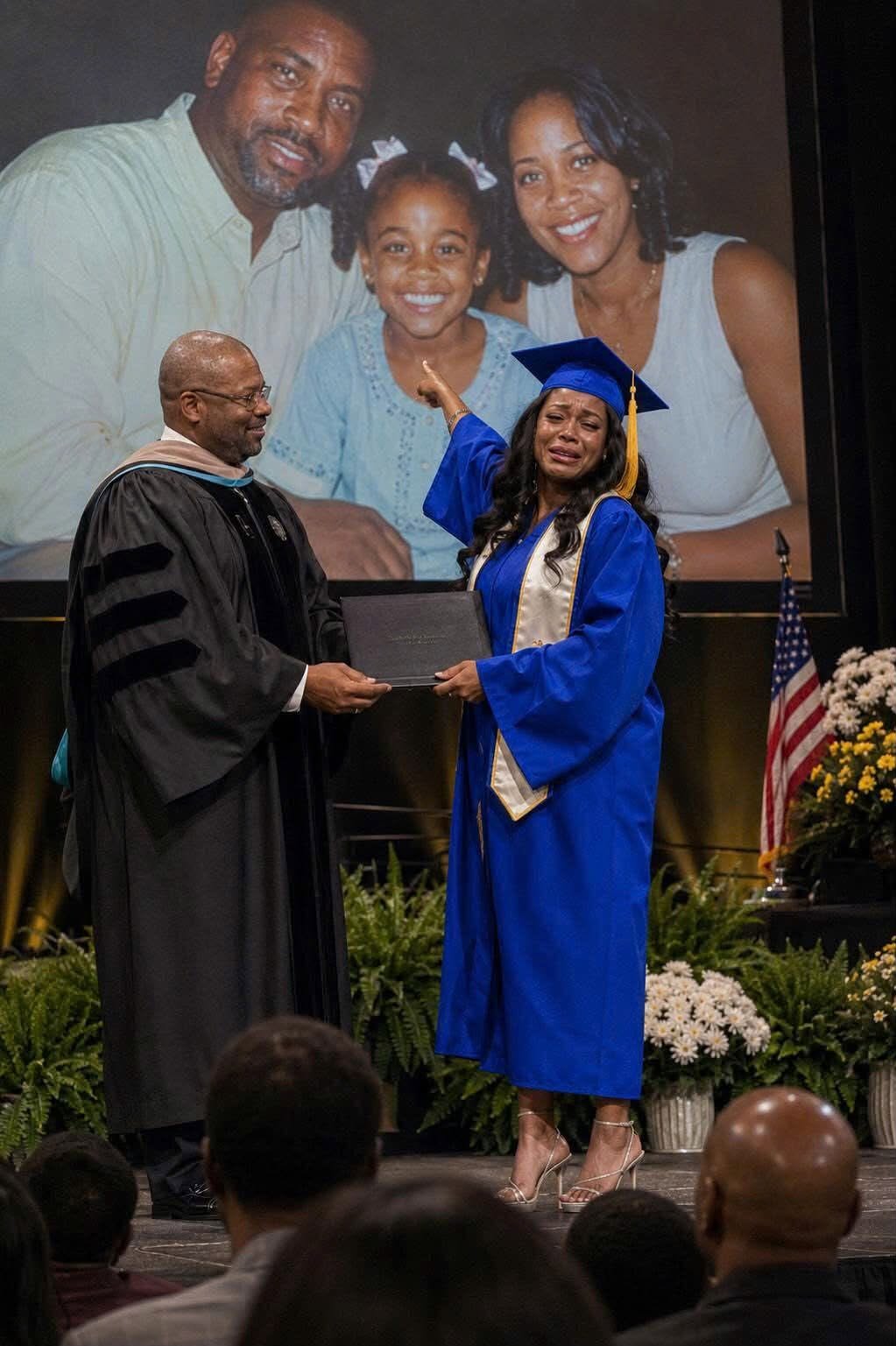
Everyone at graduation had someone cheering for them.
Everyone except me.
My parents, Daniel and Lauren Ashby, died in a car accident last November, on a stretch of wet highway outside Milbrook that I have driven past exactly once since, with my eyes closed the whole time, letting my grandmother steer.
Since then, it’s just been me and her. Vivian Ashby — my father’s mother, the woman who moved into our house within a week of the funeral because she refused to let me finish my senior year alone, even though “alone” turned out to be a more complicated word than either of us expected.
She was the one who raised half of who I am to begin with, long before any of this happened. She taught me to drive on the same empty road she now avoided taking me down. She was, for most of my life, both a grandmother and something closer to a best friend, the kind of woman who’d let you skip school for a bad day but would also march you back the next morning without a word of judgment.
But her hands had started shaking by January. Small tremors at first — a cup rattling faintly against its saucer when she poured tea, a pen wobbling across a grocery list. By March, she got winded just walking to the end of our driveway to collect the mail, standing there afterward with one hand pressed to her chest, waving off my concern before I’d even finished asking if she was okay.
I knew, somewhere around April, that she wasn’t going to make it through a graduation ceremony. The heat, the standing, the noise — her cardiologist had already used the word “caution” more times than either of us wanted to count.
At school, people noticed things too, in the quiet, half-embarrassed way teenagers notice a classmate’s grief without knowing what to do with it. I ate lunch by myself most days, at the end of a table near the vending machines. I walked to my car alone every afternoon, past clusters of kids trading rides and plans I was never invited into anymore, not out of cruelty, just the ordinary drift that happens when your life stops looking like everyone else’s.
After the last pep rally of the year, I watched half the senior class take photos with their families in the parking lot — parents holding up signs, siblings hoisted onto shoulders, everyone shouting names into the spring air. I stood a few feet off to the side, pretending to check something on my phone, like I had somewhere more important to be.
I didn’t. I never did, that whole year. I just didn’t want anyone to watch me not belonging to any of it.
I.
I almost didn’t go to graduation at all.
“What’s the point,” I told my grandmother the morning of, standing in the kitchen in my cap and gown, the fabric feeling like a costume for a role I didn’t want anymore, “if no one’s even going to be there?”
Grandma Vivian set down her tea — carefully, both hands wrapped around the cup to steady the shake — and looked at me for a long moment before she spoke.
“I’ll be there in spirit,” she said. “And you’ll be there in person, because I raised you better than a girl who quits twelve years of school twenty minutes before the finish line.” She reached across the table and took both my hands in hers, and I felt, even through the tremor, how firm her grip still managed to be. “Just get your diploma, sweetheart. One last day. Do it for me, if you can’t yet do it for yourself.”
I went. Mostly because arguing with her, even at her weakest, had never once worked in my favor.
What I didn’t know that morning — what I wouldn’t learn until much later that same day — was that my grandmother had spent the last three weeks of her failing strength writing a single letter, in handwriting that must have cost her more effort than she ever let on, addressed to someone I hadn’t spoken to in over a year.
I didn’t know the letter had already been answered.
II.
The someone was my brother, Caleb.
Caleb is six years older than me, which meant that by the time I really started forming memories of him, he was already halfway out the door toward his own adult life — but not before he’d spent years being exactly the kind of older brother who taught me to ride a bike by running alongside me longer than his own legs probably wanted to, who used to sneak me extra dessert when our parents weren’t looking, who called me “Peanut” well past the age where I found it charming instead of embarrassing.
He enlisted in the Army the summer after his second year of college, three years before any of this happened, and it broke something between him and our father that never fully healed before it ran out of time to.
Dad had wanted him to finish his degree and come back to Milbrook to help run Ashby & Sons Hardware, the store our family had owned for two generations, the same store Dad had inherited from his own father and always assumed, without ever quite saying it out loud, that Caleb would inherit from him.
Caleb had other plans. He told our father, over a dinner I remember mostly as raised voices and a slammed door, that he didn’t want the store, that he wanted to serve, that he’d already signed the paperwork before he’d even worked up the nerve to say any of it out loud.
Dad didn’t take it well. Neither of them did, honestly, in the months that followed. Caleb left for basic training with things still unresolved between them, and what started as a rough patch calcified, slowly, into something closer to permanent distance — holiday calls that got shorter every year, a visit home that kept getting postponed, a rift that neither of them seemed to know how to be the first one to close.
The last real conversation I had with Caleb, before all of this, was a phone call fourteen months before my graduation, during my junior year. He’d called to say he was extending his current deployment instead of coming home for my junior showcase like he’d promised, and I remember being furious enough to hang up on him mid-sentence, telling him he could just stop calling altogether if he was never actually going to show up for anything.
He mostly did stop calling, after that. I told myself, for over a year, that I didn’t care.
III.
He learned about our parents’ deaths nine days after the accident.
I found this out much later, from Grandma Vivian, who’d been the one to finally track him down through the emergency family contact channels the Army keeps for exactly this kind of nightmare, after days of trying every number and email address any of us had for him and getting nothing back.
He was stationed somewhere overseas at the time, in the middle of an assignment his unit couldn’t pull him out of on short notice, communications restricted in a way that meant even the worst kind of news took over a week to reach him. By the time it did, the funeral had already happened. He requested emergency leave anyway, Grandma told me — she still had the message he’d sent her, apologizing, explaining that his request had been denied due to the sensitivity of his current assignment, that there was nothing anyone on his end could do to get him home in time.
I didn’t know any of that for months. All I knew, in November, watching two caskets get lowered into ground still soft from an early frost, was that my brother wasn’t there. That the one sibling I had left in the world hadn’t come, hadn’t called, hadn’t done anything except send a single message to our grandmother that she never showed me, out of some instinct to protect me from one more disappointment during a season already overflowing with them.
I decided, in the silence that followed, that I simply didn’t have a brother anymore. It was easier than the alternative — sitting with the fact that I might, and that he’d chosen not to show up anyway.
I remember the exact night I made that decision official in my own head. It was two weeks after the funeral, and I was going through my father’s phone — Grandma had asked me to back up the photos before she had it disconnected — when I found a string of unanswered texts he’d sent Caleb over the previous year. Short ones, mostly. Hope the new assignment is going well. Nora made varsity, thought you’d want to know. Call when you get a chance, no rush. Every single one left on read, or not read at all, a slow record of a father reaching toward a son who kept not reaching back.
I closed the phone and told myself I understood exactly what kind of person my brother had become. I didn’t leave much room, that night, for the version of the story where the silence went both directions, or where reasons existed that I simply hadn’t been given yet.
I was wrong about almost all of it, though I wouldn’t understand how wrong until three weeks before I put on that cap and gown.
IV.
Grandma Vivian found the letter while cleaning out my father’s home office in early May, going through the drawers of his desk the way you do when you’re trying to decide what to keep and what finally, mercifully, to let go of.
She told me about it herself, sitting on the edge of my bed the night before graduation, once I’d already gone to sleep angry and come back downstairs for water and found her still awake, waiting, like she’d known I would.
“I found something of your father’s,” she said. “Back in May. I wasn’t going to tell you about it until I understood what to do with it myself.”
“What was it?”
She reached into the pocket of her cardigan and pulled out a folded, slightly yellowed envelope, the seal still unbroken, my brother’s name written across the front in handwriting I would have recognized anywhere, because I’d spent eighteen years watching that same hand write grocery lists and birthday cards and every homework note I ever needed signed.
“Your father wrote this to Caleb,” she said. “Dated the second week of October. A month before the accident. He never sent it.”
My chest went tight. “You read it?”
“I did,” she admitted. “I know that wasn’t entirely mine to do. But I needed to understand what I was holding before I decided what came next.”
“What did it say?”
She was quiet for a moment, her thumb tracing the edge of the envelope without opening it further.
“It said he was sorry,” she told me. “That he’d spent three years being too proud to admit he was wrong about the store, about the argument, about all of it. It said he was proud of Caleb — actually proud, in a way he’d apparently never once managed to say out loud while your brother was still speaking to him. It said he wanted to fix things before too much more time went by.” Her voice caught. “He was one month away from mailing it, Nora. One month. And then the accident happened, and it just sat in that drawer instead, saying everything it needed to say to no one.”