I didn’t know what to do with my hands, sitting there. I didn’t know what to do with any of it.
“Why are you telling me this now?” I asked. “The night before graduation, of all nights?”
“Because it’s not the only letter I wrote this month,” she said. “I found your father’s letter in early May, and I sat with it for almost two weeks before I understood what I was supposed to do with it. And then I wrote one of my own — to Caleb, care of his unit’s family readiness office, the same way I’d finally managed to reach him back in November. I told him about the accident, about how you’ve been since, about how you almost didn’t want to walk across that stage tomorrow because you didn’t think anyone would be there to see you do it. And I sent your father’s letter along with mine, because I thought — if anything in this world was going to bring your brother home, it would be his own father’s voice, finally saying the thing he ran out of time to say himself.”
V.
“You sent it three weeks ago,” I said slowly, doing the math even as the words left my mouth. “And you’re only telling me now?”
“I didn’t want to get your hopes up,” Grandma said, “in case leave got denied again, the way it did in November. I couldn’t watch you brace for another disappointment on top of everything else you’ve carried this year. So I decided I’d only tell you if — ” She stopped herself.
“If what?”
She looked at me for a long moment, and something in her face — tired, careful, working very hard to stay composed — told me she’d already said more than she’d planned to.
“If it worked,” she said finally. “And it did. I got his answer eight days ago, Nora. He requested emergency leave the same afternoon he read both letters. It was approved this time — there’s no critical assignment holding him back right now, thank God, nothing standing in his way. He’s been in transit for the last three days.”
My heart was pounding in a way that had nothing to do with grief anymore.
“Where is he?”
“I don’t know exactly,” Grandma admitted, a small, tired smile breaking through despite everything. “Somewhere between here and wherever he started. He told me not to tell you the details. He wanted tomorrow to be his to explain, in his own way, in his own time. I only agreed to keep the secret because he begged me to, and because some part of me thought you deserved one good surprise this year, after everything else it took from you first.”
I sat with that for a long moment, turning the envelope over in my hands without opening it, feeling the weight of a month my father never got to finish and a year my brother had spent trying, apparently, to find his way back through more silence than either of them had meant to build.
“Can I read it?” I finally asked. “Dad’s letter. Before tomorrow.”
Grandma hesitated. “I think,” she said slowly, “that letter was written for your brother’s eyes first. I don’t know if it’s mine to hand over twice before he’s even had the chance to hold it himself. But I promise you this — once he’s read it in front of you, however that happens, you’ll get every word of it too.”
I understood, even through my disappointment, that she was right. Some things were owed to the person they were written for before they belonged to anyone else, even a daughter who’d spent seven months grieving the same man who’d written them.
I didn’t sleep much that night. I lay awake replaying fourteen months of silence, trying to decide whether I was more angry or more hopeful, and finding, somewhere close to dawn, that I couldn’t fully separate the two feelings anymore.
VI.
The morning of graduation, Grandma Vivian sat in the front row of folding chairs set up on the football field at Fairview Crest High School, a blanket over her knees despite the June warmth, her hands folded tightly in her lap the way they did whenever she was working hardest to hide how much effort it took her just to be present.
I scanned the crowd once, out of habit, out of the same old instinct that had cost me a year of pep rallies and parking-lot photos. I didn’t see anyone else who belonged to me. I told myself that was fine. I told myself I already knew that, and I’d made my peace with it the night before, whatever half-formed hope Grandma’s story had planted in me.
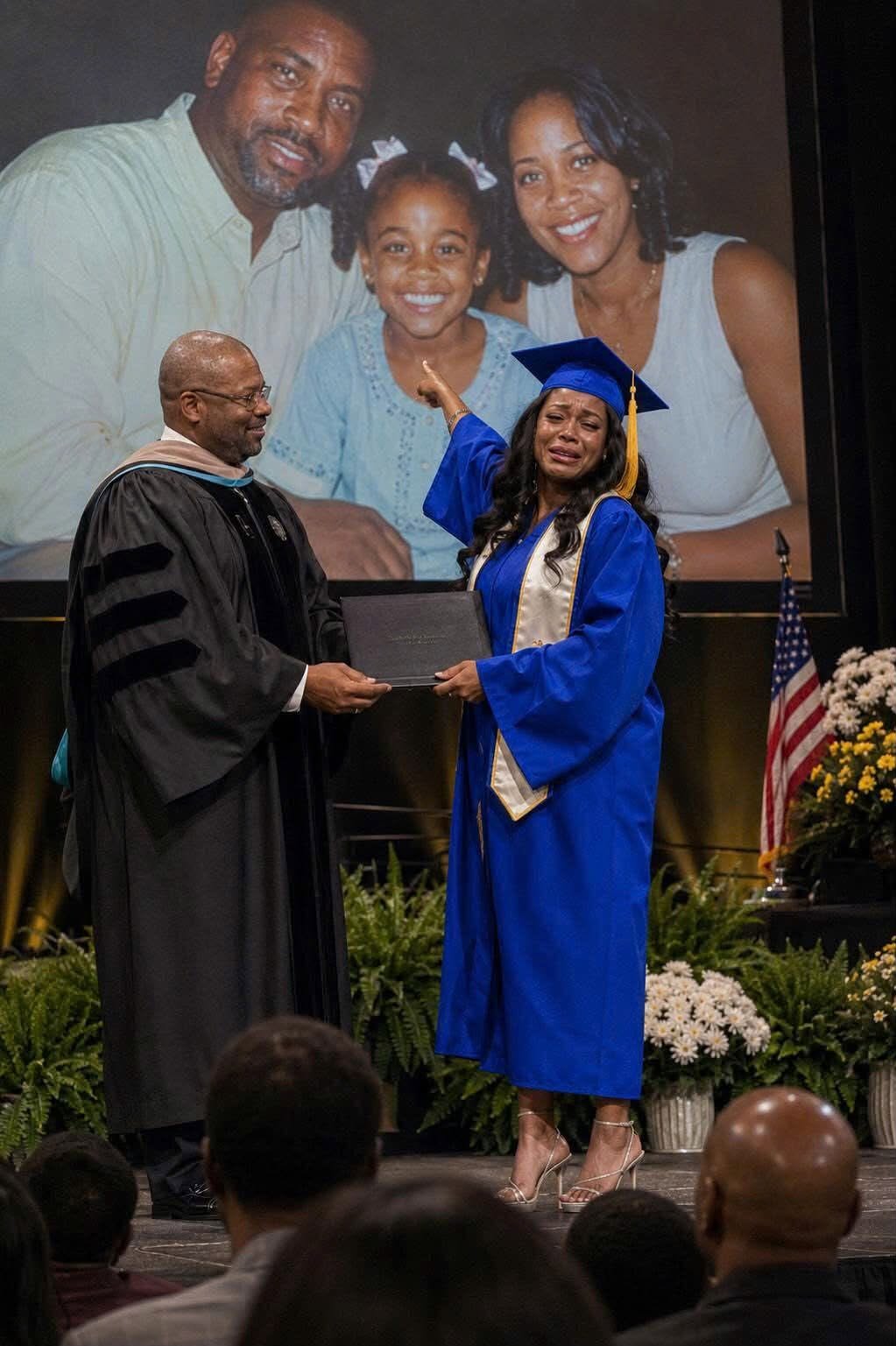
Names were called in alphabetical order. Mine came somewhere in the second third of the program — Ashby, Nora — and I walked across that stage the way you walk when you’re trying very hard not to cry in front of four hundred strangers and the handful of people who actually love you.
I remember, in the seconds before my name was called, glancing once more toward the crowd, half hoping and half bracing myself against the hope, the way you do when you’ve already been disappointed enough times to distrust your own optimism. I saw Grandma’s blanket-covered knees, her small determined wave. I saw rows and rows of families who weren’t mine. I told myself, one more time, that this was simply what my graduation was always going to look like, and that I could survive one afternoon of it the same way I’d survived the seven months before it.
I shook the principal’s hand. I took my diploma. I turned toward the crowd, the way we’d been instructed to during rehearsal, plastering on a smile for a photographer I didn’t know and an audience that was clapping the same polite, general applause they’d given every name before mine, the sound of people cheering for someone else’s child while waiting for their own.