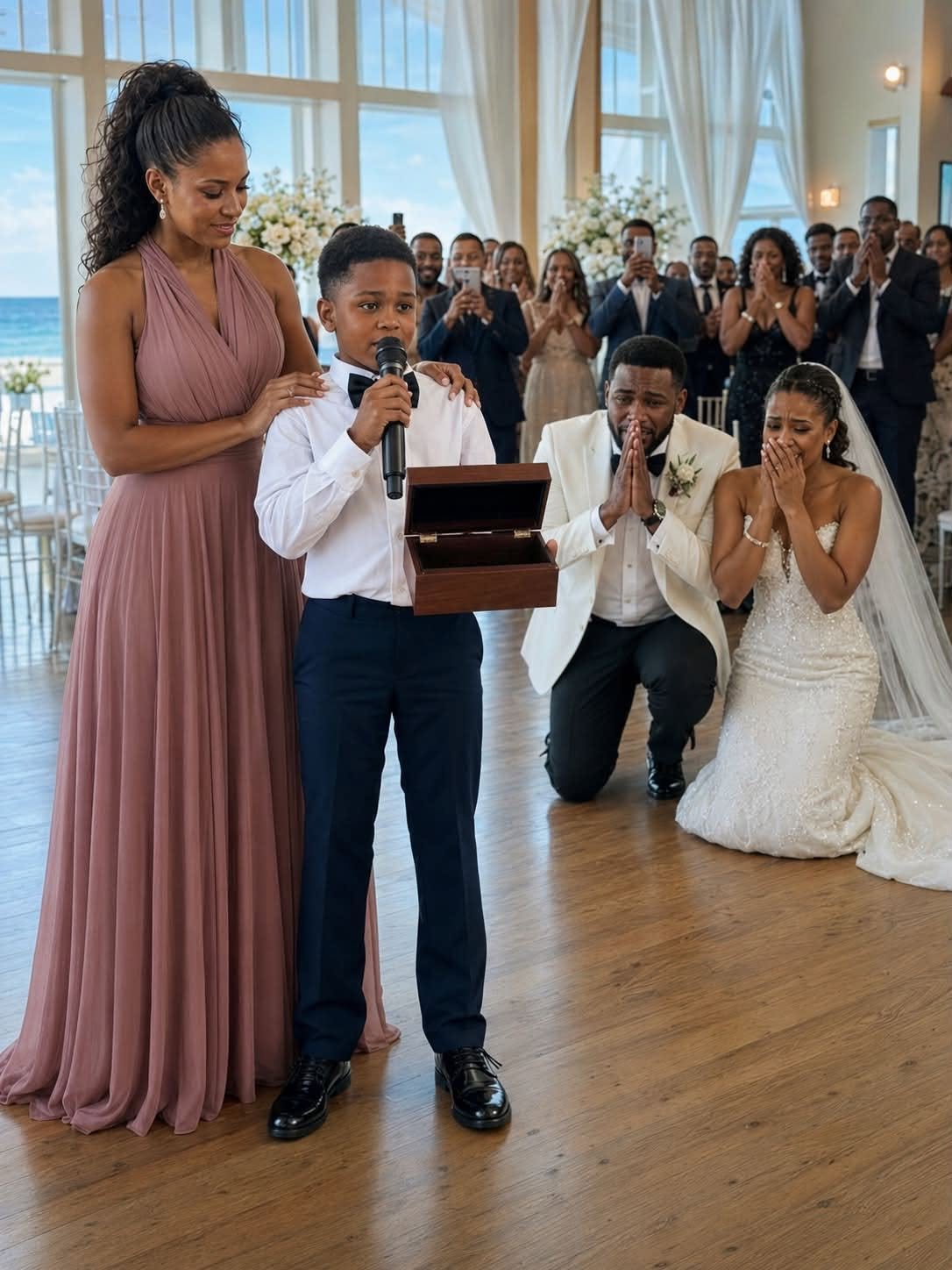
Eli and I left ten minutes later.
We passed the cake without anyone cutting it.
The jazz band had stopped playing.
Guests stood in clusters whispering.
Some were already leaving.
On the terrace, I heard someone arguing loudly.
I never turned around.
In the parking lot, Eli climbed into the passenger seat and shut the door.
I walked around to the driver’s side, got in, and simply sat there.
Neither of us spoke.
Finally, I turned toward him.
“Eli.”
He stared through the windshield.
“Are you mad?”
The question broke something inside me.
“No.”
“Because I read Dad’s messages.”
“I wish you never had to see them.”
He nodded.
Then he whispered, “I didn’t want to show you.”
“Why not?”
“Because you were getting better.”
I swallowed.
He picked at the seam of his trousers.
“After Dad left, sometimes I heard you crying when you thought I was asleep.”
I closed my eyes.
“I didn’t want to make you do that again.”
“Then why tonight?”
He turned toward me.
“Because tonight everybody was laughing.”
His voice cracked.
“And you were sitting there pretending it didn’t hurt.”
I reached across the console and pulled him into my arms.
He was eleven years old.
He should have been worrying about basketball practice, video games and whether he could stay awake past midnight.
Instead, he had spent months carrying evidence of his father’s betrayal because he thought protecting me was somehow his responsibility.
I held him until his breathing slowed.
Then I told him something I should have said much earlier.
“You never have to protect me from your father.”
He pulled back.
“But—”
“No.”
I wiped his cheeks.
“That is my job. I protect you.”
He nodded reluctantly.
Then he said, “Can you still give the card to your lawyer?”
I almost laughed through my tears.
“Yes.”
That part, I could do.
I called my attorney Monday morning.
By Wednesday, she had hired a forensic accountant.
What they uncovered made the affair look almost simple.
For nearly two years, Caleb had routed bonuses and investment distributions through shell companies connected to a college friend.
One account contained more than four hundred thousand dollars.
Another held proceeds from a property sale Caleb had claimed produced almost no profit.
There were investment statements, transfer instructions and emails discussing how certain assets could be kept “outside the marital picture” until after the divorce was complete.
My attorney petitioned the court to reopen the financial portion of our settlement.
Caleb fought it.
Then he settled.
The amount he ultimately paid me was substantial, but the money was never the most satisfying part.
The satisfying part was the correction.
For years, Caleb had controlled the story because he spoke first, spoke loudly and spoke confidently.
Now there were documents.
Dates.
Bank records.
Messages.
Truth that didn’t care how charming he was.
Sloane filed for an annulment almost immediately.
I heard through mutual acquaintances that her father also ended two pending development deals with Caleb’s company.
Caleb wasn’t fired.
That would have allowed him to call himself a victim again.
Instead, several major clients quietly stopped returning his calls.
By winter, he had sold his share of the company to his partners and relocated to another city.
For once, there was no dramatic farewell.
No speech.
No reinvention announcement.
He simply became smaller.
A man who had spent years curating an image finally discovered there were some things reputation management couldn’t erase.
Several months later, Eli and I were eating pizza on the living room floor when he asked me a question.