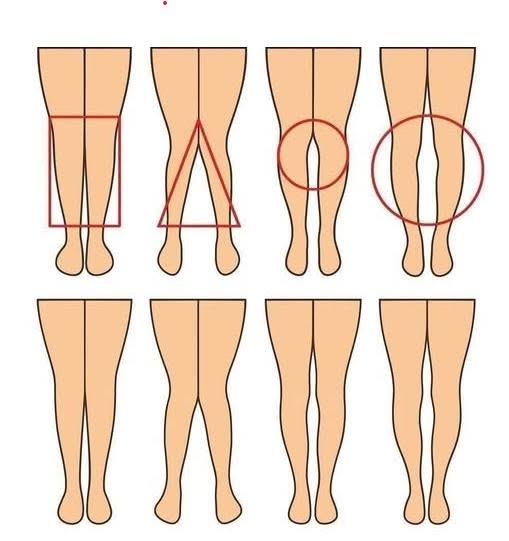
Leg alignment shapes play a fundamental role in your overall musculoskeletal balance, joint health, and daily physical performance. When you stand in front of a mirror and observe how your hips, knees, and ankles align, your lower body provides vital clues about bone geometry, muscle engagement, and posture. Understanding the mechanics behind different leg alignment shapes helps you identify structural imbalances early, prevent chronic joint pain, and support lifelong mobility naturally. 🦵
Primary Categories of Leg Alignment Shapes
Neutral Alignment (Parallel Pattern): The hips, patellae, and ankles align in a straight vertical axis, distributing body weight evenly across both the inner and outer compartments of the knee joints.
Knock Knees (Genu Valgum): The knees touch or angle inward toward each other while the ankles remain separated, placing higher biomechanical stress on the lateral knee structures.
Bowlegs (Genu Varum): An outward curvature where the ankles touch but the knees remain noticeably separated, shifting joint load primarily to the medial cartilage.
False Bowlegs (Rotational Imbalance): The upper legs and knees align closely, but an excessive gap appears below the knees due to weak calf support, hyperextended joints, or internal femoral rotation.
Step-by-Step Self-Assessment for Leg Alignment Shapes
Stand on a Flat Surface: Remove shoes and socks, then stand upright with your feet pointing straight forward and inner ankle bones gently touching.
Check Knee Proximity: Look down to see if your knees touch effortlessly, press inward against each other, or leave a wide open space between the joints. 🔍
Examine Lower Leg Gaps: Check whether your calves and shins meet naturally or if there is an isolated inward rotation below the patella.
Observe Foot Arches: Look at your inner arches to determine whether flat feet (overpronation) are causing your ankles and knees to collapse inward.
Track Movement Mechanics: Perform a slow, controlled bodyweight squat in front of a mirror to observe if your knees track inline with your second toe or cave inward. ✨
The Biomechanical Science Behind Leg Alignment Shapes
To understand why different leg alignment shapes develop, it is essential to analyze the kinetic chain linking the pelvis, femur, tibia, and feet. Your leg posture is determined by a blend of skeletal architecture, ligamentous laxity, and muscular symmetry.
When muscle imbalances arise—such as tight hip adductors combined with underactive gluteus medius muscles—the femur naturally rotates inward. This rotation alters the Q-angle (the angle between the quadriceps tendon and the patellar tendon). A wide Q-angle shifts joint friction toward the kneecap and lateral menisci, altering your gait and creating distinctive leg alignment shapes that impact how impact forces travel up the spine. 🌿
Key Benefits of Correcting Structural Imbalances,,,